Categories
Home Buying Home Selling Real Estate

Sarasota County Single-Family Home Market Update

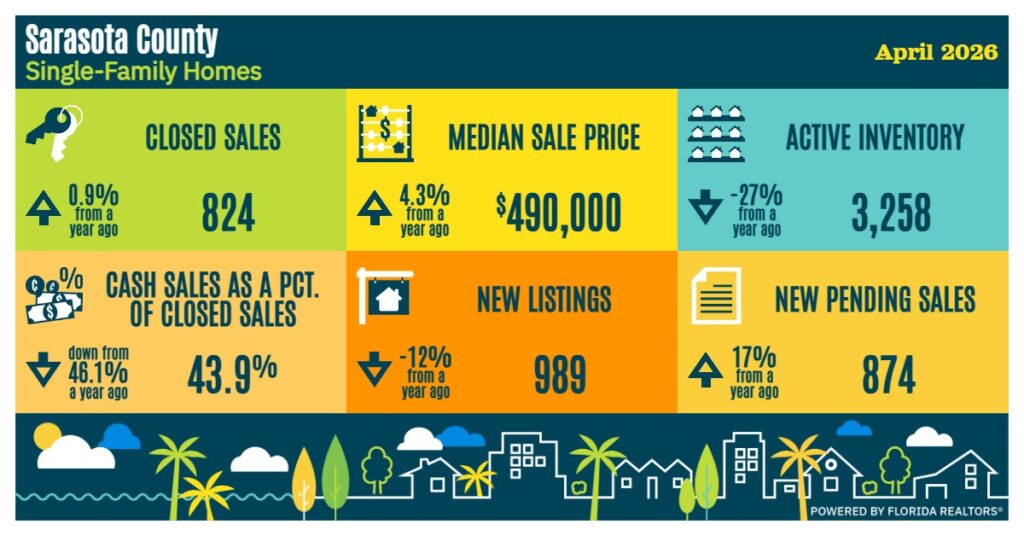
Sarasota County’s single‑family home market in April 2026 showed modest growth in sales and prices. Closed sales reached 824, up 0.9% year‑over‑year, while the median sale price rose to $490,000, an increase of 4.3% from a year earlier. New pending sales were strong at 874, up 17%, indicating continued buyer activity despite mixed listing trends.

Supply tightened significantly compared with last year: active inventory fell to 3,258, down 27%, and new listings dropped to 989, down 12%. Cash purchases accounted for 43.9% of closed sales, a slight decline from 46.1%. See the infographic below, from Florida Realtors, for more.

Cooling Off Self-Exclusion Options UK

Why the Clock Stops for Gamblers

Look: the moment a player feels the urge to hit “just one more bet,” the brain’s reward circuit lights up like a neon sign. In the UK, that flash can be throttled by a cooling-off period, a legal safety net that forces a pause before the next spin. The problem? Many operators hide the option behind jargon, and users stumble into a loop of denial.

What the Law Actually Says

Here is the deal: the Gambling Commission mandates that every licensed site must offer a self-exclusion tool, plus a mandatory 24-hour cooling-off window for anyone who flags an issue. It’s not a suggestion; it’s a rule etched into the licensing code. If you’re not seeing it, the operator is breaching the contract.

Standard Cooling-Off Durations

Most platforms default to a 24-hour lockout, but you can extend it to 48, 72 hours, or even a permanent ban. The choice is yours, but the initial 24-hour block is non-negotiable — no “just a minute” loophole. The moment you click “self-exclude,” the system flips a switch, and the account is frozen tighter than a bank vault.

How to Activate the Feature

By the way, the activation steps are usually tucked under “Responsible Gambling” or “Account Settings.” Click the link for a step-by-step guide: cooling-off self-exclusion options UK. Once you confirm, an email confirmation lands in your inbox, and the timer starts ticking.

Common Pitfalls and How to Avoid Them

First, don’t assume the cooling-off is a “soft” ban. Some players think they can call customer support and get an immediate lift — wrong. The only way out is to wait out the period or request a formal review after it expires. Second, beware of “temporary lifts” that some sites offer for a fee; they are often a money-grab, not a genuine help tool.

Psychology Behind the Freeze

And here is why the forced pause works: it breaks the dopamine loop, giving the brain time to recalibrate. Studies show that a 24-hour gap reduces relapse rates by up to 30 percent. The longer the lockout, the more likely the player will seek professional help instead of chasing the next jackpot.

What to Do If You’re Stuck

First, contact the operator’s responsible-gaming team — mandatory by law. They must provide a clear pathway to either extend the cooling-off or move to a permanent exclusion. Second, keep a record of every email and screenshot; it’s your evidence if the regulator steps in. Third, consider external support groups; the isolation of a locked account can feel crushing, but you’re not alone.

Bottom line: the cooling-off self-exclusion option is a legal hammer, not a suggestion. Activate it the moment you feel the itch, and let the enforced break do its job. No more excuses, just a clear, hard stop. Get on it now.

How to Verify Curacao Licence UK

Why the Check Matters

Look: the moment you stumble upon a casino flashing a Curacao seal, you either trust it blindly or you start digging. The latter is the smart move, especially when UK players are on the line. A licence from Curacao isn’t a blanket of safety; it’s a piece of paper that can be forged, misread, or simply misunderstood. And here is why you need a razor-sharp verification process.

Step One – Locate the Licence Number

First, hunt down the licence number on the site’s footer. It’s usually a string of letters and digits, something like “Curaçao eGaming # 8048/JAZ”. If it’s missing, you’ve already hit a red flag. No number, no credibility.

Pro Tip

By the way, the number isn’t just decorative; it’s the key you’ll feed into the regulator’s database.

Step Two – Hit the Official Registry

Head straight to the Curacao eGaming website. There’s a search bar where you paste the licence number. If the site spits out a match, you’ve got a legit badge. If it returns “not found”, you’re looking at a copy-cat operation. Simple as that.

Step Three – Cross-Check with the UK Perspective

Now, a Curacao licence alone doesn’t guarantee UK compliance. The UK Gambling Commission demands its own vetting. So, hop onto the UKGC’s public register and type the casino’s name. No entry? That’s a warning sign. The casino may be operating without UK approval, which could leave you unprotected under UK law.

Here’s the deal

Even if the Curacao licence checks out, you still need to verify that the operator respects UK standards for player protection, data security, and fair play. The two systems don’t talk to each other, so you have to do the legwork.

Step Four – Test the Customer Support

Dial the support line or fire off a live chat. Ask for the licence details again. Real operators will repeat the exact number and maybe even give you the URL of the regulator’s page. If they fumble, you’ve uncovered a weak spot.

Step Five – Use Independent Review Sites

Search for third-party reviews. Sites that specialize in gambling analysis often list licence info and flag dubious operators. One solid source is the article on how to verify Curacao licence UK. It breaks down the exact steps and even warns about common scams.

Step Six – Check for SSL Encryption

Look at the URL bar. A lock icon and “https” mean the site encrypts data. Not a licence check per se, but a missing lock is a sign the operator might be cutting corners elsewhere, including licensing compliance.

Step Seven – Verify the Physical Address

Enter the address listed on the site into Google Maps. Does it lead to a real office building, or is it a vacant lot? A legitimate Curacao licence holder will have a traceable corporate address, even if it’s a virtual office. Anything else is suspect.

Final Move

Pull all the pieces together: licence number matches Curacao registry, UKGC register confirms the operator, support repeats the details, SSL is active, and the address checks out. If any link is broken, walk away. No more excuses.
Live Strategy for Virtual UK Greyhound Racing

Why the Current Approach Fails

Most bettors treat virtual greyhound like a slot machine, pressing buttons on autopilot. The result? A bank account that looks like a ghost town. The core problem is a lack of adaptive strategy – you’re playing static odds with dynamic data, and that mismatch drains you faster than a sprinting hound.

The Anatomy of a Winning Play

First, you need to understand the feed. Virtual races pull randomised speed matrices from a proprietary engine. Those matrices aren’t pure luck; they’re weighted by historical performance, track condition simulations, and a dash of algorithmic bias. If you ignore the weightings, you’re essentially betting on a roulette wheel that’s been rigged for the house.

Read the Pace, Not the Price

Look: the odds displayed are just the surface. Dive into the pace charts – the split times for each virtual segment. A greyhound that consistently accelerates in the final 200 metres will have a higher win probability even if its odds look long. Spot the pattern, and you’ll start to out-maneuver the engine.

Bankroll Allocation, the Real Game-Changer

Here is the deal: allocate 70% of your stake to the top-rated dog, 20% to the dark horse that shows a late-race surge, and 10% to a hedge on the favourite’s rival. This isn’t a suggestion; it’s a rule. Anything else is gambling with a blindfold.

Tools You Can’t Afford to Ignore

By the way, a simple spreadsheet that tracks the last 50 virtual races will reveal the hidden bias. Plot the win rates against the simulated track condition variable. You’ll see a curve that peaks around a specific moisture index – that’s your sweet spot.

And here is why most novices miss the mark: they never calibrate their model. They keep betting the same fraction regardless of variance. Variance spikes when the engine updates its random seed, typically at the top of each hour. Adjust your stake size accordingly, or you’ll be the one left holding the bag.

Putting It All Together

Step one: log into the virtual platform, pull the last 30 race results, and feed them into your spreadsheet. Step two: identify the dog with the highest acceleration in the last quarter. Step three: apply the 70-20-10 bankroll split. Step four: watch the odds shift, and if they drift beyond your calibrated threshold, abort the bet and re-evaluate.

Remember, the virtual world doesn’t care about sentiment; it cares about data. If you treat it like a casino, you’ll lose. Treat it like a lab, and you’ll profit. The final piece of actionable advice: set an automated alert for any odds movement beyond 0.15 on your selected dog, then execute the 70-20-10 split instantly. That’s how you stay ahead of the algorithm and keep the green flowing.

For more nuanced tactics, check out the detailed guide on live strategy virtual UK greyhound.

Trainer Form: Why It Matters More Than You Think

What’s Broken in Your Routine?

Most people treat a trainer form like a checklist, a bureaucratic afterthought. Look: it’s the pulse of your entire program, the hidden lever that decides whether you’re scaling or stalling. If you skim it, you’re basically flying blind.

The Core Issue: Data Blindness

Imagine trying to navigate a city without a map — yeah, that’s what ignoring a trainer form feels like. It strips you of the granular insights that separate a champion from a washout. And here is why: every column, every signature, every timestamp is a data point screaming for attention.

Why Short-Term Fixes Fail

People love quick hacks. They slap a new diet on a client, swap a rep scheme, and expect miracles. But without a solid form tracking progress, you’re just guessing. The form tells you if the client’s heart rate spikes, if recovery windows are respected, if the load is too heavy. Miss that, and you’re courting injury.

Real-World Consequences

Take the case of a gym that dismissed the trainer form as paperwork. Within weeks, dropout rates doubled, injuries spiked, and morale plummeted. The root? No one knew who was overtraining, who was under-challenged, who simply needed a tweak. The form would have highlighted patterns before they became catastrophes.

How to Turn the Form Into a Weapon

First, stop treating it like a formality. Make it a living document. Use vivid language in the notes — “muscle fatigue like sandpaper” instead of “tired”. That mental shift forces you to notice nuances. Second, integrate technology: a simple spreadsheet or a cloud app can auto-alert you when metrics cross thresholds. Third, enforce a ritual: every session ends with a 30-second debrief on the form. No excuses.

Tools That Actually Work

Don’t waste time on generic templates. Grab a platform that’s built for this chaos. For instance, the trainer form on https://dogracingfastresults.com/trainer-form/ offers real-time analytics, customizable fields, and a sleek UI that makes data entry feel less like a chore and more like a strategic move.

Mindset Reset

Stop thinking of the form as paperwork. Think of it as your secret weapon, your early warning system. If you’re not logging the minutiae, you’re leaving money, reputation, and client health on the table. The next time you walk into a session, grab that form, fill it out with purpose, and watch the ripple effect.

Actionable Takeaway

Right now, open your trainer form, add a column for “energy level 1-10”, and commit to updating it after every client. That single tweak will start feeding you the data you need to make smarter decisions — fast.